How to Spot Fake Reviews on Amazon (Before They Cost You)
Generic praise, suspiciously perfect scores, and review spikes that appeared overnight. Fake reviews are everywhere — here's exactly how to spot them and shop smarter.
This post contains affiliate links — we may earn a small commission at no extra cost to you.
Here's something Amazon won't tell you: a four-star rating means almost nothing on its own. What matters is whether those stars were earned.
Fake reviews are a real, documented problem across Amazon's marketplace — and they've gotten sophisticated. Gone are the days of obviously broken English and five-star raves from accounts created yesterday. Today's fake reviews look real. They're written in polished, friendly prose. They show "Verified Purchase." They have helpful votes. And they will absolutely lead you to buy something mediocre at best, useless at worst.
Here's how to read through them.
The Red Flags Worth Knowing
Not every bad review is fake. Not every glowing review is suspicious. But when you see several of these together, your instincts are right — something is off.
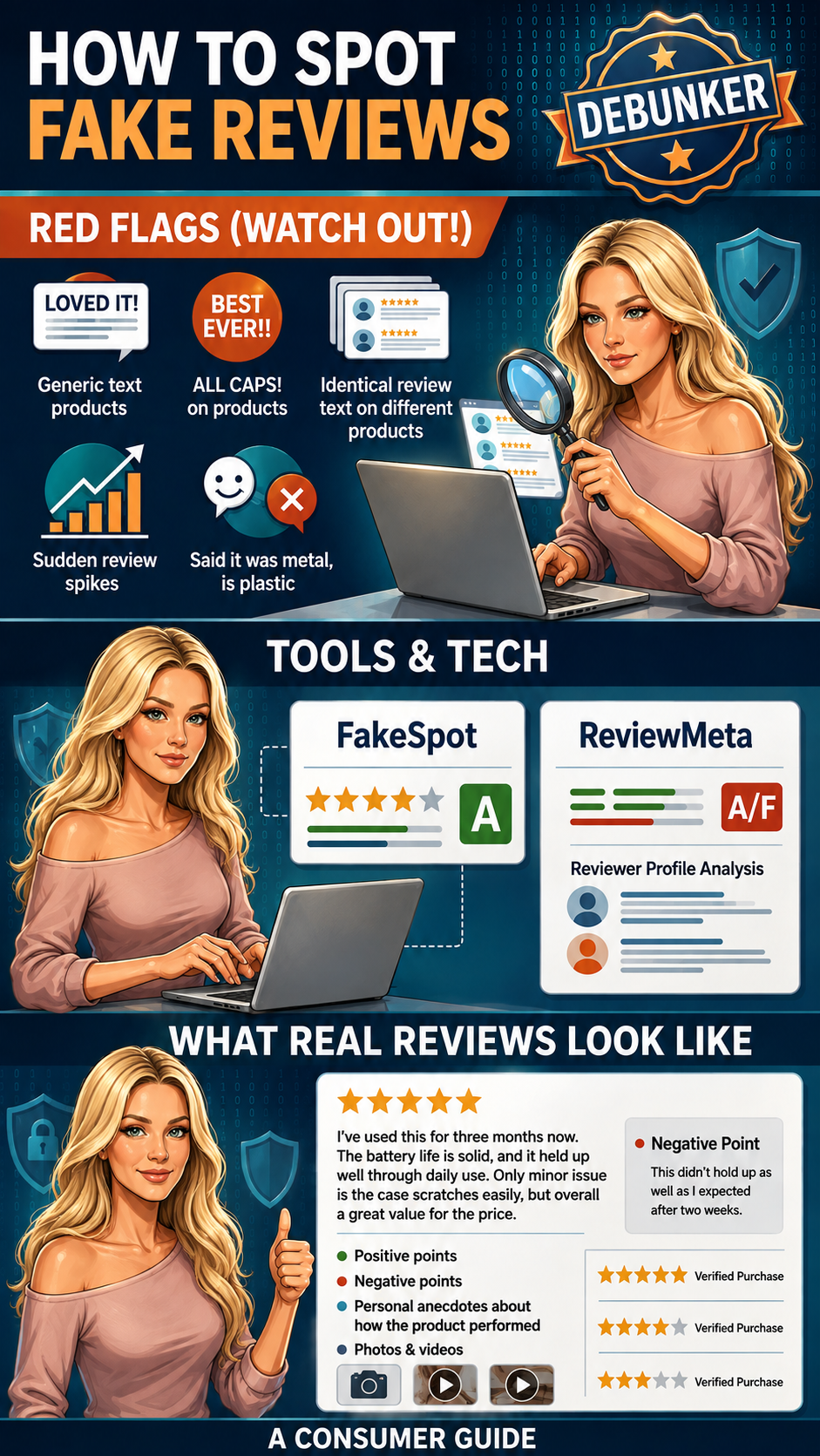
- Generic, content-free praise. "Great product! Very happy with this purchase. Highly recommend!" tells you nothing. Real reviews talk specifics: the texture of the serum, how long the battery lasted, whether the sizing ran small. If a review could have been written about literally anything in the product's category, it probably was.
- ALL CAPS ENTHUSIASM. "ABSOLUTELY LOVE THIS!!! GAME CHANGER!!!" Punctuation is not a substitute for detail. Incentivized reviewers often write with exaggerated excitement because they're trying to perform positivity rather than share an actual experience.
- Identical or near-identical reviews across products. If a reviewer's profile shows them giving five-star reviews to unrelated products — a kitchen appliance, a supplement, a phone case, a beauty tool — in the same week, they didn't buy all of that. Check reviewer profiles when something feels off.
- Sudden review spikes. A product with 12 reviews in January and 847 reviews by February didn't earn those organically. This is one of the clearest signals. The review tracking tools (more on those below) make this visible without any guessing.
- Material claims that don't match the product category. Skincare that "cleared my acne in two days." Hair products that "regrew my edges in a week." Reviews that make claims no legitimate product could deliver are either fake or written by people who don't understand what they bought.
The Tools That Do the Work For You
You shouldn't have to do this analysis manually every time. Two free tools handle it automatically:
- Fakespot — Paste in any Amazon product URL and Fakespot grades the reviews from A to F. It uses machine learning to identify patterns consistent with review manipulation: posting velocity, reviewer behavior, linguistic patterns, and more. It also has a browser extension that overlays grades directly on Amazon search results, which is genuinely game-changing for browsing.
- ReviewMeta — Similar concept, slightly different methodology. ReviewMeta shows you what the "adjusted" rating would be if suspicious reviews were removed. The gap between Amazon's displayed rating and ReviewMeta's adjusted rating tells you a lot. A product sitting at 4.7 stars that ReviewMeta adjusts to 3.1 is telling you something important.
Both are free. Both are worth the two minutes it takes to use them before a significant purchase.
What Real Reviews Actually Look Like
Once you've spent time reading fake reviews, real ones become obvious. They're specific and a little messy. Real reviewers mention what they compared the product to before buying. They note the exact problem they were trying to solve. They describe what surprised them — positively or negatively.
Real reviews include both good and bad points. The serum absorbs beautifully but the pump broke after two months. The sneakers run a half-size small and the sole is stiffer than expected but the leather is legitimately beautiful. Real experience is complicated. Fake experience is uniformly perfect.
Look for:
- Specific personal context — "I have dry, sensitive skin and this didn't irritate me at all" is real. "Great for all skin types!" is not.
- Honest mixed opinions — When someone names one or two things they'd change, that's credibility. Nobody who was actually paid to review something leads with the downsides.
- Photos and videos — These take effort. Most fake review campaigns don't bother. Images that show real wear, real skin texture, real use — that's the signal you're looking for.
- Verified purchases with review history — Not foolproof (incentivized reviewers do buy the products), but a reviewer with a consistent history of reviewing things in categories they actually care about is more trustworthy than an account with 200 five-star reviews and nothing else.
The Bottom Line
You don't need to become paranoid about every review on Amazon. Most products are legitimately reviewed. But for anything new, anything expensive, or anything making strong claims — run it through Fakespot or ReviewMeta first. It takes thirty seconds and it will save you from returning things you should never have bought.
Trust the reviews with specifics. Be skeptical of the ones that glow without saying anything.