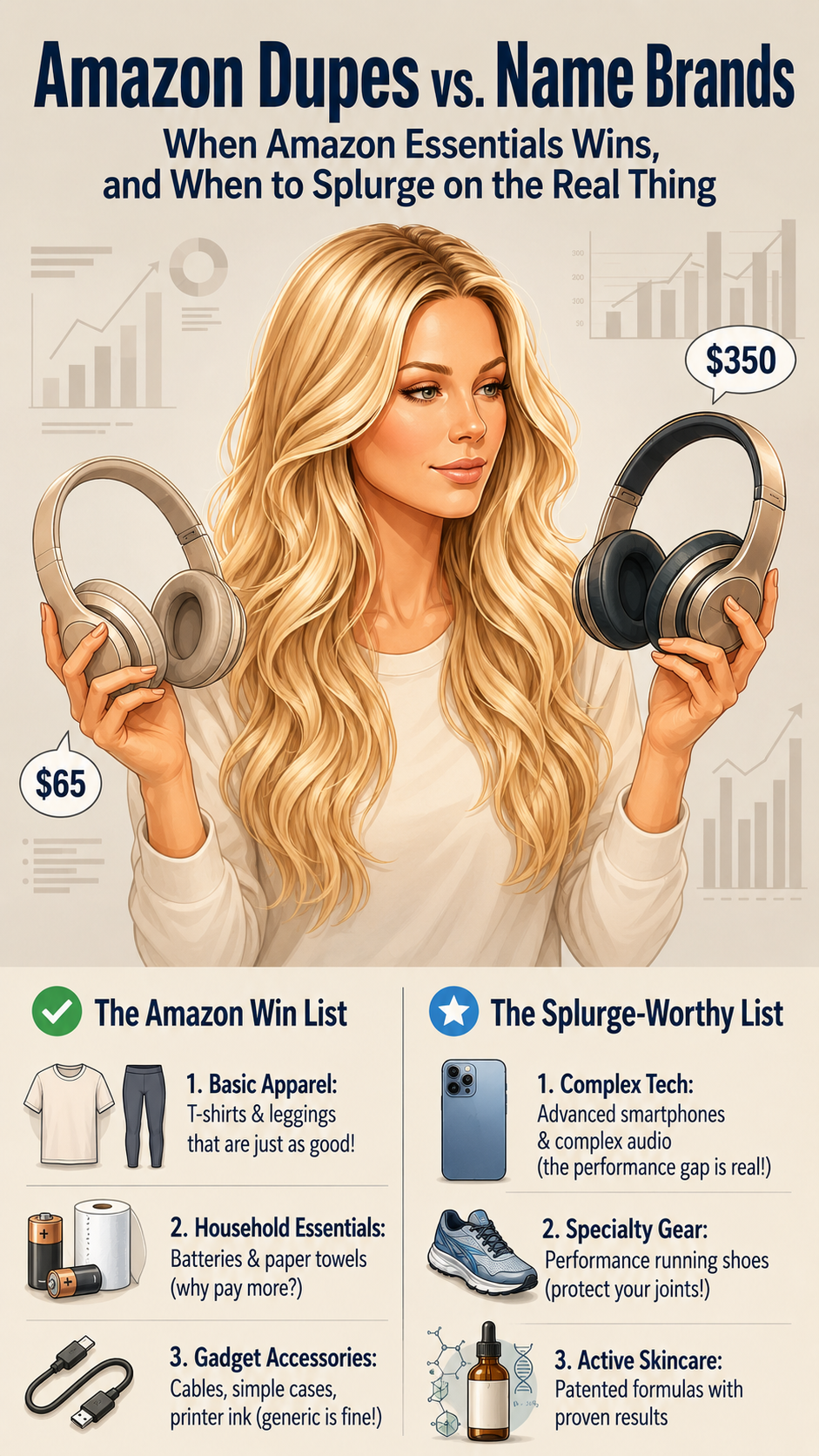
Amazon Dupes vs. Name Brands: What's Actually Worth It
Some things Amazon sells at a fraction of the name-brand price and the quality difference is basically zero. Other things you should absolutely spend the money on. Here's the list.
This post contains affiliate links — we may earn a small commission at no extra cost to you.
There's a version of this conversation that goes: "Amazon dupes are just as good as the real thing, always buy the cheap version." And there's another version that goes: "Never compromise, buy the best, you'll regret it otherwise."
Both of those are wrong. The truth is more useful.
Some things are functionally identical whether you spend twenty dollars or two hundred. Other things — the difference is real, it's meaningful, and the name brand exists for a reason. Knowing which is which is the whole game.
The Amazon Win List: Buy the Dupe
These are categories where the generic or Amazon-brand version genuinely competes with — or beats — the name brand, and paying extra doesn't get you much.
Basic Apparel
T-shirts, basic leggings, loungewear, simple knits — these are the fashion categories where the gap between a name brand and an Amazon find is often just the logo and the markup.
Basic tees in neutral colors are one of the highest-yield Amazon buys. The fabric on a well-reviewed Amazon basic tee (look for 4.4+ stars with detailed reviews about softness and durability) can be indistinguishable from what you'd pay significantly more for at a brand boutique.
Everyday leggings — not high-performance athletic leggings, but your around-the-house, low-key workout, errand-running leggings — are another area where Amazon delivers. Read the reviews carefully for specifics on opacity and waistband hold, and you'll find solid options at a fraction of the name-brand price.
Loungewear and sleep sets: same logic. You're wearing them at home. The brand story matters a lot less when no one's seeing it.
Household Essentials
This is the category where buying the dupe is almost always correct, and doing otherwise is just paying for advertising.
- Batteries — Amazon Basics batteries test competitively with Duracell and Energizer in independent tests. The cost difference is significant. There is no credible argument for buying brand-name batteries at full price.
- Paper towels and household basics — Bounty has great marketing. Generic paper towels absorb liquid. Buy the cheap version. Redirect the savings.
- Cleaning supplies and laundry detergent — Unless you have a specific skin sensitivity or preference, generic cleaning products do the same job. The active ingredients are the same. The fancy label is not cleaning your floors.
- Storage containers — Tupperware has a cult following I will never fully understand. A good set of Amazon glass food storage containers will last years and doesn't cost you a shocking amount. The leftovers don't know what brand the container is.
Gadget Accessories
Another category where the dupe wins, almost across the board.
- Charging cables — As long as they're certified (look for MFi certification for Apple products), the brand doesn't matter. A braided charging cable from a reputable Amazon seller holds up as well as the name brand. Buy a three-pack and stop mourning lost cables.
- Phone cases — The job of a phone case is to not crack when you drop it. Amazon cases do this. Unless you specifically want a designer collaboration or a very specific aesthetic, the function is identical at a fraction of the price.
- Laptop sleeves and tech bags — If it's not your main bag — if it's purely functional — an Amazon sleeve works as well as one three times the price.
The Splurge-Worthy List: Buy the Real Thing
Now for the other side. These are the categories where the name brand, the premium option, or the specialty product genuinely outperforms the dupe — and cutting corners ends up costing you more in the long run.
Complex Tech: Smartphones, Headphones, Audio
The performance gap between a premium product and a budget product in consumer electronics is measurable and real. A discount true wireless earbud might function, but the audio processing, noise cancellation depth, and long-term durability of a premium pair are genuinely different. If you use headphones every day — for work, for commuting, for workouts — the quality difference is felt daily.
Premium headphones and earbuds are an area where buying once, right, costs less over time than buying cheap twice. The build quality, the driver technology, the noise cancellation algorithms — these are engineering differences that don't dupe cleanly.
Same logic applies to smartphones, cameras, and anything where computational power or sensor quality drives the output.
Performance Athletic Gear
The basic leggings argument does not extend to technical athletic wear. If you're running distance, training seriously, or doing anything where your gear is genuinely working — moisture management, compression, durability under stress — the difference between budget and premium athletic gear is real and felt in your body.
Performance running shoes are a specific area where I will not argue for the cheap option. The midsole foam, the shoe's ability to return energy, the support structure for your specific gait — these are engineered differently at the premium tier. A budget running shoe for serious running is a joint problem waiting to happen.
Sports bras for high-impact activities, technical base layers for outdoor use, compression gear for recovery — same principle. The function is doing real work, and the real thing does it better.
Active Skincare: The Formula Is the Product
This is the nuanced one. Basic moisturizers? Often dupe-able. A reliable drugstore SPF? Absolutely fine. But active skincare — products with working concentrations of retinol, vitamin C, peptides, acids, or patented delivery systems — is a different story entirely.
With active skincare, the formula is the product. A vitamin C serum with 15% L-ascorbic acid in a pH-stable formulation does not dupe cleanly against a "vitamin C" product with a low concentration of a less effective derivative. The package looks similar. The results don't.
For your active ingredients — the ones you're buying to actually change your skin — buy from brands with published formulations, dermatologist backing, or clinical data. The names you probably already know. They exist for a reason.
For moisturizer, cleanser, and SPF? The dupe conversation is much more open.
The Framework
Here's how I think about it: when you're buying something where the primary job is function and function is easy to verify (does it charge my phone? does it hold leftovers? does it absorb spills?), buy the Amazon version. When you're buying something where the performance gap is real and you'll feel it in daily use (audio quality, athletic support, skin results), spend on the version that actually delivers.
That's it. No ideology about dupes or name brands — just a practical split between where the gap is real and where it isn't.